Tryst Link Journal
Five Eyes Now Measures the AI Cyber Threat in Months, and the Ivanti Scramble Shows Why
Five Eyes agencies warn AI is shrinking exploit windows to hours. The Ivanti CVE-2026-10520 case shows this is already happening, not a future scenario.
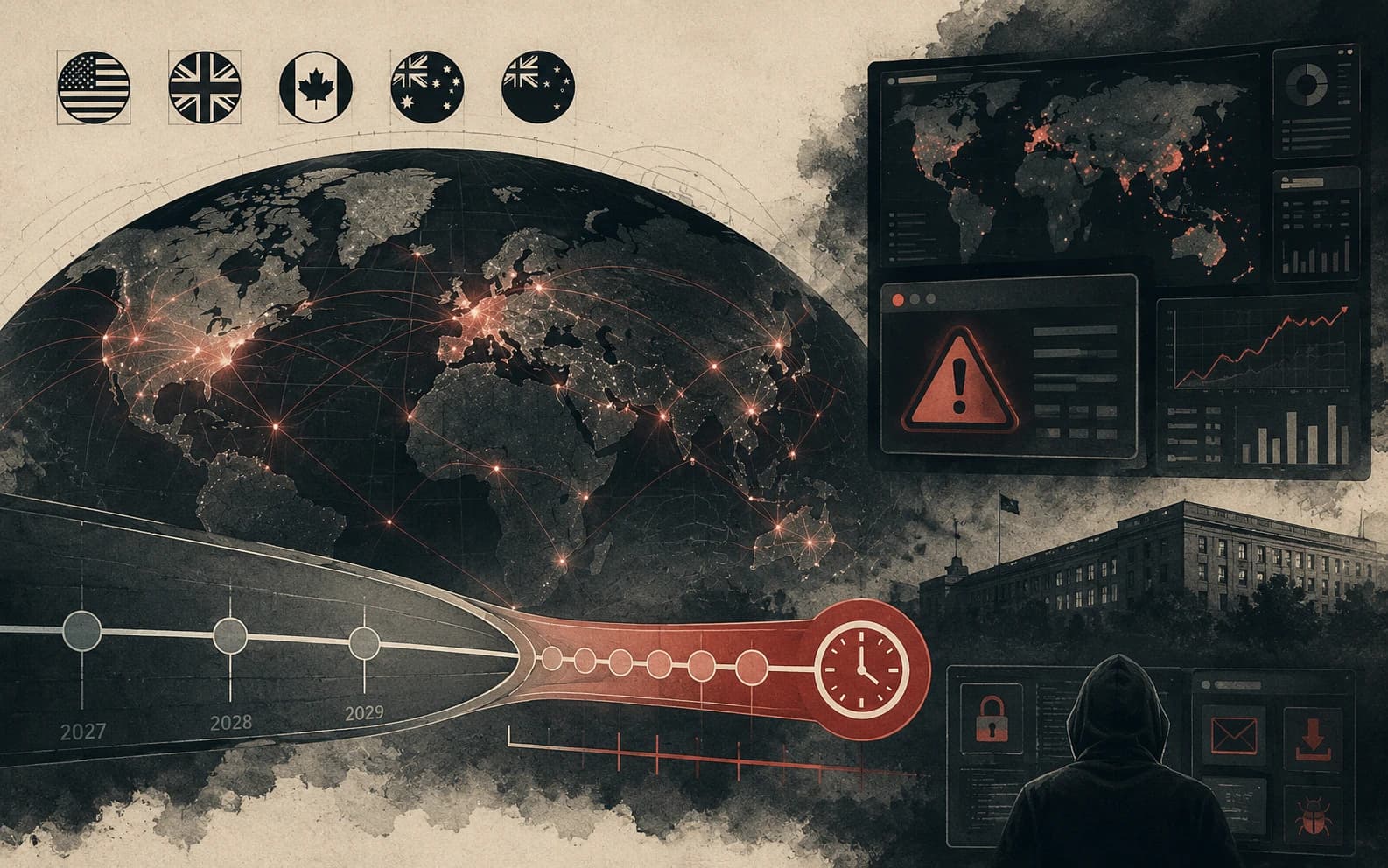
On a Sunday in mid-June, US federal agencies were given three days to fix one flaw in Ivanti Sentry, a gateway appliance that sits on the edge of corporate and government networks.
The bug, CVE-2026-10520, carried a perfect severity score of 10.0. Attackers began backdooring internet-exposed Sentry gateways within about forty hours of a public proof-of-concept exploit going live. Forty hours. That single number is the entire argument behind the warning the Five Eyes agencies released a week later, on June 22.
By the time a patch exists, someone with the right tooling may already be sitting inside your network.
What the statement actually says
The cyber agencies from the United States, United Kingdom, Canada, Australia, and New Zealand put their names to a three-page joint statement. It explicitly states that frontier AI models are expected to exceed current industry expectations, fundamentally transforming both offensive and defensive cyber capabilities.
Joint statements at this level are uncommon, which is part of why it landed the way it did.
Aside
Frontier AI models shrink the exploit window from weeks to hours. The operational challenge is no longer about finding better advice—it is about acting on the advice you already have before the clock runs out.
The substance, though, was thin on specifics. The statement was light on detail and mostly restated core cybersecurity advice—patching faulty software quickly and not putting systems online unless necessary—while also urging defenders to use AI to identify weaknesses sooner and respond to incidents faster. The agencies were upfront that none of this is new, but noted these habits are now urgent to reduce technical, operational, financial, and reputational exposure.
Not everyone was impressed. US security advisor Joseph Steinberg called it a "generic statement of the obvious" that did not offer meaningful guidance on the specific risks AI creates. That criticism is worth holding onto, because the gap between the urgency of the framing and the familiarity of the advice is the most interesting thing about the document.
It named no models, but the timing pointed straight at Anthropic
The statement itself flagged no company. It did not directly mention any specific AI model, though industry analysts read it as referring to Anthropic's latest models. The reason that reading took hold is the timing. Just before the statement went out, the US government banned foreign use of Anthropic's Mythos and Fable models on national security grounds.
What makes those particular models the subtext is what one of them reportedly does. Mythos 5, unveiled on June 10, can find vulnerabilities in cyber systems through large-scale code analysis. Over misuse concerns it is provided only to pre-approved institutions, while the similarly capable Fable 5 was released the same day with safeguards applied. Days later, the access situation tightened again: on June 13, Anthropic suspended worldwide access to both models amid export-control and security concerns.
This is not purely theoretical anymore. Google's Threat Intelligence Group noted it blocked a case where a software vulnerability discovered by AI led to an actual attack, presumed to involve Russia-based hackers using AI models, with signs that Chinese and North Korean groups had attempted similar efforts.
The 72-hour patch rule
The mechanism behind the deadline is CISA's Binding Operational Directive 26-04, issued on June 10, 2026. It requires federal civilian agencies to patch vulnerabilities meeting high-risk criteria within three calendar days—the most aggressive standing timeline in the directive's history—citing AI-accelerated exploitation as the reason.
The three-day clock is conditional, not universal. Agencies must patch within 72 hours only when a vulnerability meets three specific criteria:
| Requirement | Condition | Core Risk |
|---|---|---|
| Exposure | Exposed to the public internet | Immediate perimeter visibility |
| Exploitation | Listed in the Known Exploited Vulnerabilities (KEV) catalog | Active real-world threat vector |
| Automation | Exploit execution can be fully automated | Scalable by machine-speed tooling |
| Control | Grants an attacker system control | Critical operational compromise |
Flaws that meet similar criteria but cannot be exploited automatically get up to fourteen days, and agencies have a hundred and eighty days to adopt the new timelines. There is also a forensic wrinkle for the worst cases: where a flaw could let attackers take complete control, agencies must investigate whether a compromise already happened before applying the patch.
The Ivanti Sentry case from the opening was the directive's first real-world enforcement, with its June 14 deadline landing three days after the flaw hit the KEV catalog.
Five old habits with a new clock attached
The advisory closes with five practical moves, and reading them against the accelerated threat model is the entire point.
- Reduce your attack surface: Challenge whether systems need to be exposed at all and isolate those that do not.
- Accelerate patching: Treat patch cycles as continuous operations. AI is destroying the gap between discovery and exploitation.
- Address legacy systems: The agencies frame these as strategic liabilities rather than mere technical debt.
- Strengthen identity and access controls: Strong authentication and regular permission reviews are non-negotiable.
- Prepare for incidents in advance: Assume breaches will occur. Focus on fast containment and isolation rather than perfect prevention.
The framing shift matters more than the list. The agencies argued cyber risk can no longer be treated as a purely technical issue—calling it a core business risk and leadership responsibility, with boards and executives expected to confirm that controls actually perform under a real incident rather than just exist on paper.
What this means for defenders
The honest summary of where this leaves a security team is a little uncomfortable. The advice is the same advice it has always been—the patching, the access controls, the tested incident plans. What changed is the time you have to do it in.
Australian Cyber Security Centre head Stephanie Crowe noted she was positive about the tools and capabilities already available, provided organisations actually take the time to review their risk management plans and act. UK NCSC chief Richard Horne framed the moment as needing a step change in collective cyber defence.
A forty-hour window from public exploit to active backdooring is not a future scenario the agencies are bracing for. It already happened, to Ivanti customers, this month.
Further reading
If you are evaluating your team's readiness against automated discovery systems, read our deep dive on analyzing the edge architecture of gateway appliances or explore the baseline configuration steps required under CISA Binding Operational Directives.
Questions, answered
Frequently asked
- What did the Five Eyes agencies warn about?
- The cyber agencies from the US, UK, Canada, Australia, and New Zealand issued a joint statement warning that frontier AI models will fundamentally transform offensive capabilities much faster than expected—with timelines shrinking to months rather than years.
- What is CVE-2026-10520 and why does it matter?
- It is a perfect 10.0 severity flaw in Ivanti Sentry gateway appliances. It serves as a real-world example of the AI threat model: attackers began backdooring internet-exposed gateways within forty hours of a public proof-of-concept going live.
- What are CISA's new 72-hour patching rules?
- Under Binding Operational Directive 26-04, US federal civilian agencies must patch internet-exposed, automated, and actively exploited vulnerabilities within three calendar days. The aggressive timeline was explicitly enacted to combat AI-accelerated exploitation.