Tryst Link Journal
WhatsApp Usernames Go Live: Meta Finally Steps Away From the Phone Number
WhatsApp introduces global username reservations, closing a long-standing privacy gap. Here is how the rolling rollout affects personal privacy and business integrations.
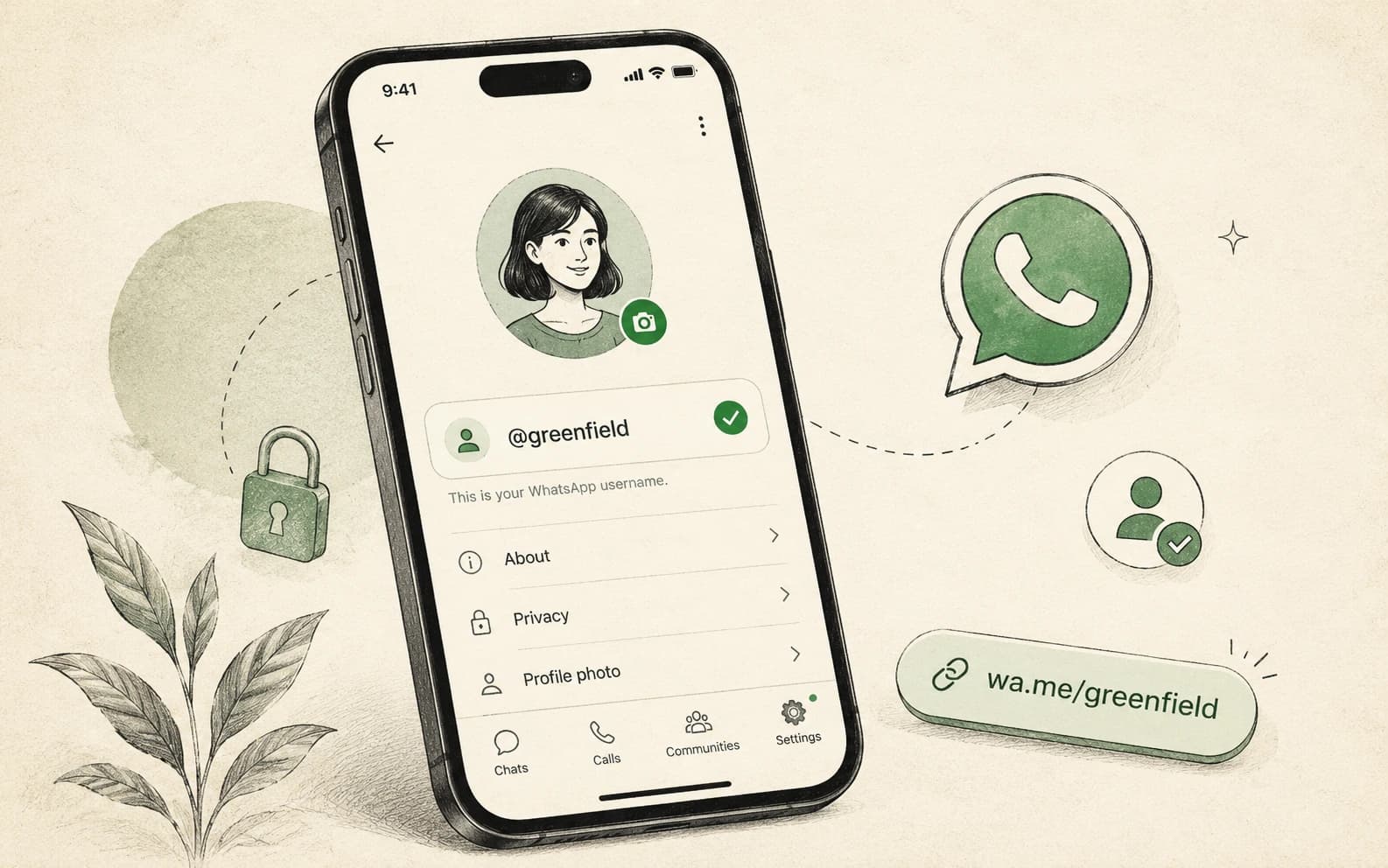
The Meta-owned app, which counts more than three billion users globally, announced on Monday, June 29, that it has begun letting users reserve unique usernames. The full feature, which will let people be found and contacted only by a handle rather than their phone number, will roll out over the coming months.
For an app that has spent its entire existence using your phone number as your core identity, this is a significant architectural change. It is also highly overdue. Rivals like Telegram and Signal have offered handle-based contact layers for years.
Until now, WhatsApp's privacy protections have been distinctly reactive—forcing users to block individual bad actors or silence unknown callers after their phone number had already been exposed.
How to reserve your handle right now
Reservations are active globally, though individual availability depends on when the latest app build propagates to your device store. To secure your handle, follow these baseline steps:
- Update the application: Ensure you are running the absolute latest version of WhatsApp via the iOS App Store or Google Play Store.
- Navigate to settings: Open WhatsApp, tap your profile icon or enter the Settings menu panel.
- Access account parameters: Tap on your profile card or navigate to Account, then look for the new Username options field.
- Claim an available name: Input your desired handle. If it matches the validation rules and isn't taken, hit save to lock it down.
To prevent mass phishing campaigns and automated brand impersonation, Meta has implemented strict character constraints alongside defensive name-squatting filters:
| Rule Category | Constraint | Anti-Fraud Goal |
|---|---|---|
| Length | Between 3 and 35 characters long | Minimizes short character domain squatting |
| Character Set | Lowercase letters, numbers, ., and _ | Standardizes input structure |
| Domain Blocking | Cannot start with www or end in .com/.net | Blocks fake web-address handles |
| Entity Protection | Reserved blocks for celebrities, public figures, and brands | Reduces malicious impersonation |
Enter the 'Username Key'
The reservation rush is entirely predictable, but the real engineering highlight is what WhatsApp calls the Username Key.
Because people tend to reuse identical handles across Instagram, X, and TikTok, an attacker could easily guess your WhatsApp username. The Username Key solves this by introducing an optional secondary password layer for first-time interactions.
If a user enables the Key, first-time contacts must know both the exact username and the unique alphanumeric key code. If the handle leaks online, you can simply rotate the key inside your settings—instantly invalidating external discovery without giving up your chosen username.
What stays under the hood
This feature changes the public-facing contact interface, not WhatsApp's underlying data architecture. Meta still requires and stores your phone number. The number remains the anchor for cryptographic key distribution, two-factor SMS recovery, and back-end anti-fraud profiling.
End-to-end encryption protocols remain untouched. Your messages are still secured via the Signal Protocol; the change simply alters what identifier maps your device endpoint to another user's screen.
The enterprise integration scramble
For organizations running automated infrastructure, this change introduces immediate technical requirements. Companies that already possess customer phone numbers can continue using them without friction, but new user discovery via the WhatsApp Business API is shifting.
Developers and CRM architects must update their integrations to ingest the new Business-Scoped User ID (BSUID) format. Meta's documentation outlines a mandatory adoption window centering around mid-2026.
Furthermore, brand protection teams should treat username claiming as a priority task. While Meta has put placeholder protections in place for major enterprise brands, smaller organizations and regional trademarks face a legitimate risk of handle squatting if they delay claiming their matching properties.
Questions, answered
Frequently asked
- When can I use a WhatsApp username?
- Username reservations opened globally on Monday, June 29, 2026. The full functionality allowing users to hide their numbers completely will roll out in phases over the coming months.
- What are the naming rules for reserving a handle?
- Handles must be between three and 35 characters, use lowercase letters, numbers, underscores, or periods, and contain at least one letter. They cannot start with 'www' or end in standard web domains.
- What is the Username Key?
- The Username Key is an optional secondary privacy toggle. When active, new contacts must know both your username and this rotating secret key to initiate a chat session.